Book Lists
Own Voices Chapter Books for Dia
Move past picture books: chapter books and middle grade novels with bilingual and bicultural themes for readers aged eight to twelve.
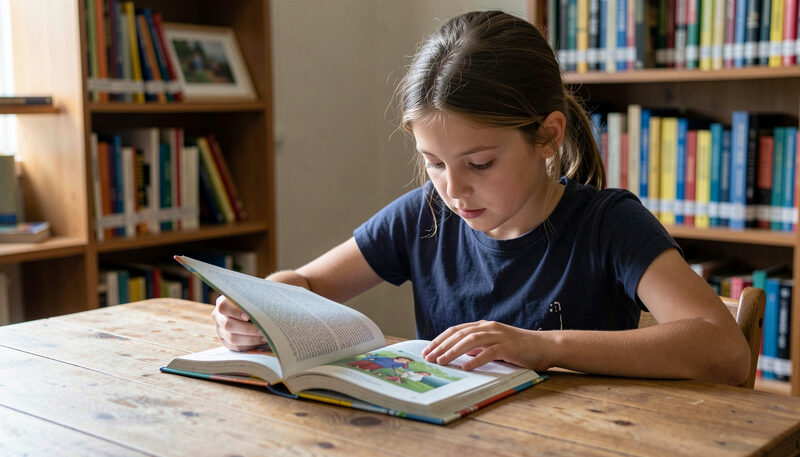
Picture books carry a Día celebration, but readers aged eight to twelve need novels, and handing them the right one is a different craft. Chapter books and middle grade titles with bilingual and bicultural interiors keep the celebration's promise for the audience most at risk of drifting from it: strong readers with strong opinions, in households where one language is losing ground to the other. This guide covers how to choose these books, what Own Voices means when a ten year old asks, and how to keep a stack of them moving between library shelves and backpacks.
What does the shelf need to hold?
Variety of experience, not variety of covers. A working middle grade shelf for Día readers holds contemporary school stories where a bilingual family is simply the setting; family stories rooted in migration, borders and two countries; fantasy and adventure where the bicultural world is the given, not the problem; and graphic hybrids, the diary and comic formats that middle grade readers pass hand to hand. It also needs funny books. A shelf entirely of serious migration stories tells a reader that books about families like theirs are always sad, which is a message no shelf should send.
What does Own Voices mean here?
The term, which spread through publishing in the last decade, points at something a middle grade reader can grasp in one sentence: a book about a culture written by someone from inside it. The point is not a certification to police, it is a selection instinct, the same inside voice check applied to picture books in Bilingual Picture Books for Story Time. We Need Diverse Books, the advocacy organization that popularized the conversation, publishes resources that explain the stakes plainly. For a librarian or teacher, the working rule is three questions: who is this about, who wrote it, and does the interior, the jokes, the food, the arguments, the silence at the dinner table, read like experience or like research.
How do you know a translation is good?
By the ears, not the cover. A good middle grade translation reads funny in the second language, because humor is the first thing a stiff translation loses. Spanish language editions of popular series vary widely in tone; a chapter read aloud in the store or from a library copy tells you more than the publisher's note. Check that cultural anchors survived: foods, terms of address, place names should remain themselves, not flattened into the nearest target language equivalent. And prefer editions where the original and the translation are both in print, because readers aged eight to twelve switch between them deliberately, reading a chapter in each to see what changed.
How do you hand-sell a novel in two minutes?
The booktalk for middle grade runs on situation and voice, the same ninety second craft the tool kit teaches for the browsing table, with one adjustment: quote the funny page. Read the passage that made you laugh out loud, name the exact reader it is for, and stop. Series order matters to this age, so know which book is first even when the cover does not say so. The booktalking method, built for Día program tables, is in The Dia Tool Kit; for this audience the strongest close is the two language offer: it is in Spanish too, same cover.
What keeps older readers reading both languages?
Access and lack of shame. A reader who finishes a novel in English and finds the Spanish edition waiting on the same shelf keeps both; a reader who has to order it and wait loses the moment. Classrooms and libraries that shelve the two editions of a title side by side, with a sticker joining them, see the pairs travel together. The summer, when school scaffolding disappears, is the season this either holds or slips; the week by week structure that keeps it standing is in A Bilingual Summer Reading Plan. Families carry the same work at home with the routines in Reading Aloud in Two Languages, which still matter at age ten, whatever the ten year old claims.
How do you build the list without freezing?
Start from the national lists and work local. The annual Día book lists from the Association for Library Service to Children include middle grade selections, and the established awards for children's literature by and about Latino communities, such as the Pura Belpré medals named for the pioneering librarian, supply a vetted backbone that refreshes itself every January. Add what your readers hand each other, which is data no list has. Keep the list living: dates and editions shift, out of print titles should leave, and the next strong season is always one order away. The selection habits, applied across ages, anchor the whole Book Lists approach of this magazine.
What about the reader who says books are boring?
Hand them the hybrid shelf and let format do the work: graphic novels, illustrated diaries, and nonfiction with teeth, combined with a booktalk that quotes the good page. The bicultural graphic novel shelf in particular has never been stronger, and it moves. A reader who returns a finished book, even a graphic one, has done the reading; the second one goes out easier than the first. The promise of Día, every child linked to books, is made to this reader most of all, and it is kept one two minute booktalk at a time.